
Digital Signage
How to use digital screens in an estate agency to highlight properties and win clients
Digital screens for estate agencies let you prioritise properties, communicate promotions and attract property owners. Discover how to structure content so your window display works for you.
From the traditional estate agency window display to a dynamic one
For decades, the window display of an estate agency has relied on printed posters, cards in the glass and photographs that fade with light. The problem isn't the aesthetics, but the rigidity: every change requires reprinting, every property competes for the same visual space and there's no way to highlight a specific opportunity. The result is often a cluttered board where no property truly catches the eye. Digital screens for estate agencies change this logic. A digital estate agency window display lets you prioritise properties, rotate messages and update information in minutes. It's not about digitising the clutter, but turning the screen into a dynamic channel that communicates what matters most at any given moment.
What should be understood in a few seconds
People walking down the street only give the window display a few seconds of attention. If they don't understand what's being offered in that time, the opportunity is lost. That's why every piece of content shown on a screen should answer a single idea: one property, one promotion or one call to attract sellers. To achieve this, you should use large fonts, high contrast and quality photographs. The essential data is few: type of transaction, location, surface area, bedrooms and price. Everything else can be left out. A common mistake is trying to show five property cards at once with small text. In digital signage for estate agencies, less is more: a legible screen is worth more than an unreadable catalogue.
Highlighting a property for sale
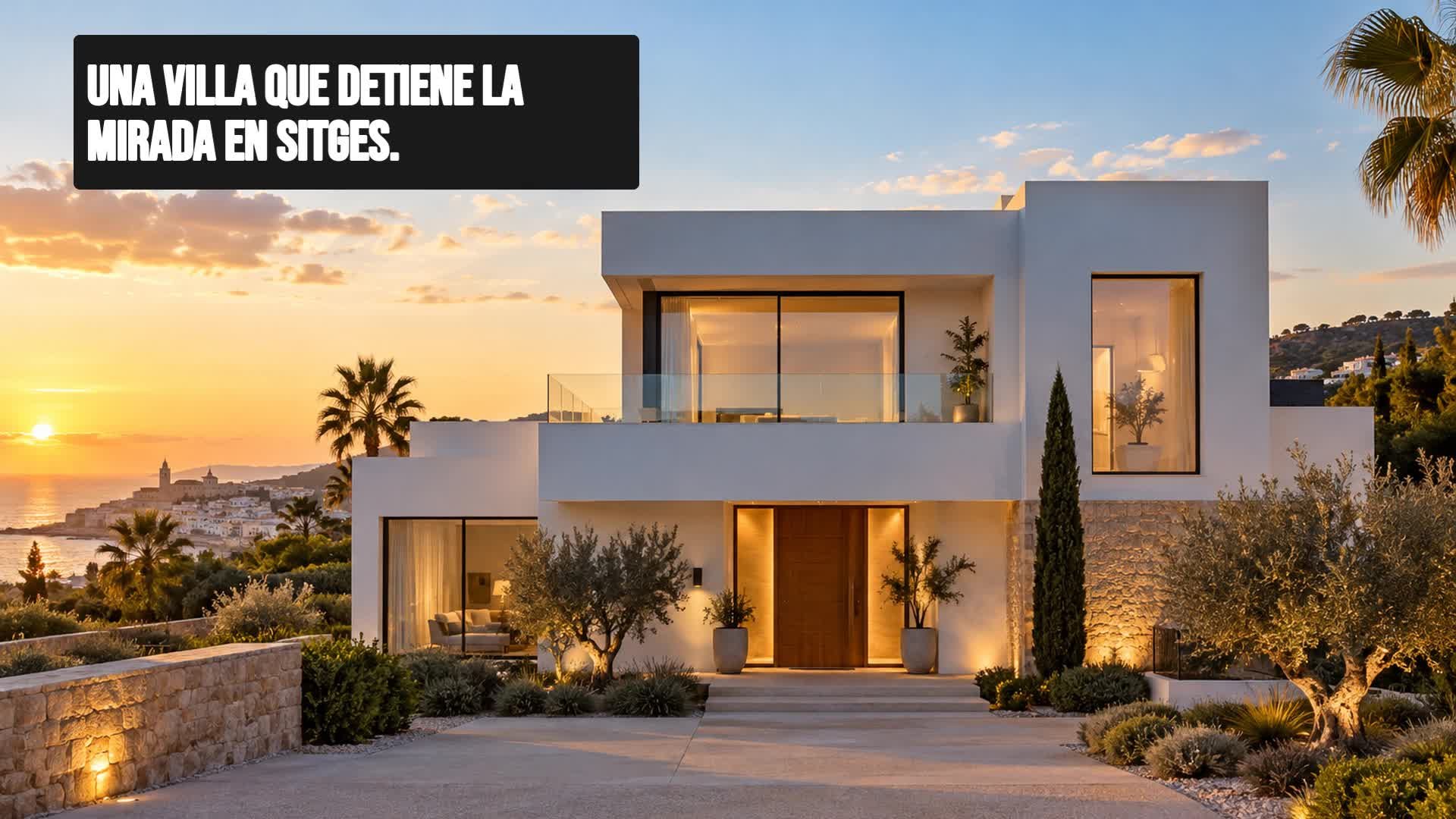
When an agency has a property it wants to sell as a priority, the screen can give it full prominence. Instead of sharing space with other property cards, that home can occupy the entire screen for a few seconds, with an attractive image and key data clearly visible. For example, a contemporary villa in Sitges with 4 bedrooms, 3 bathrooms and 210 m² can be presented with its price of €895,000 and a call to request more information. The key is to simplify: a quality photo, the name or area, the main data and a clear next step. The screen doesn't replace the visit or the conversation, but it does get the interested party to stop and ask.
Communicating a new-build promotion
New-build properties have an aspirational component that digital format can leverage better than a printed card. It's not just about showing a floor plan or a price, but conveying a lifestyle. The screen allows you to show communal areas, terraces or finishes with attractive visual sequences. A good example is Residencial Mirador, with 2- and 3-bedroom apartments, terraces and a communal pool, available from €325,000. On the screen, this content can be presented with lifestyle images, simplified floor plans and messages inviting enquiries. The goal isn't to explain everything, but to generate interest in arranging a viewing.
Using the screen to attract property owners
An estate agency's window display isn't just for showing what's for sale or rent. It can also attract new property owners who are considering selling their home. A screen in the window can ask the right question at the right time: 'Are you thinking of selling your home?'. This type of message, accompanied by a home valuation service, can generate opportunities that would otherwise slip away. There's no need to promise results or special conditions; just inviting owners to start a conversation is enough. In this way, the screen becomes a tool for sourcing sellers, as well as a showcase of properties.
Promoting properties for rent
Renting responds to a more immediate need than buying. Someone looking for a rental flat usually needs clear and quick information: location, size, monthly price and features that make the difference. The screen can show these properties in an agile and attractive way. For example, a penthouse in Barcelona with 95 m², 2 bedrooms and a terrace, for €2,150 per month, can be presented with a bright image and essential data clearly visible. By alternating rental properties with others for sale, the agency communicates that it handles different types of transactions and broadens its reach.
Example of rotation on a real estate screen
How to alternate different content without saturating the screen
The four cases above shouldn't compete with each other on the same screen at the same time. The beauty of digital signage for estate agencies is in the rotation: each piece of content has its turn, with sufficient duration to be understood and a frequency that keeps the window display varied. To avoid saturation, you should define priorities: the star property can appear more often or at times of high footfall, while owner acquisition can be scheduled for specific time slots. Remote updating allows you to adjust the programming without travelling to the office or reprinting posters. The result is a window display that always shows the most relevant content, without accumulating information.
Managing real estate screens with iMediaGO
Managing all this content manually would be complex, especially for agencies with multiple screens or frequent portfolio changes. iMediaGO offers a solution designed for real estate digital signage: it allows you to create and organise playlists, assign priorities to each property and update messages from a single place. With iMediaGO, there's no need to rely on a designer for every change or wait to print new posters. Content adapts to the agency's strategy and is published to screens quickly. In this way, the window display stops being a static element and becomes an active communication channel.
Ready to modernise your estate agency window display?
Discover how iMediaGO can help you manage your agency's digital signage, keep properties up to date and attract more opportunities.