
Restaurant marketing
How Artificial Intelligence Can Help Restaurant Marketing
AI doesn't replace your decisions: it turns them into concrete proposals based on your business's real data. Learn how to make the most of it with a practical example.
Introduction
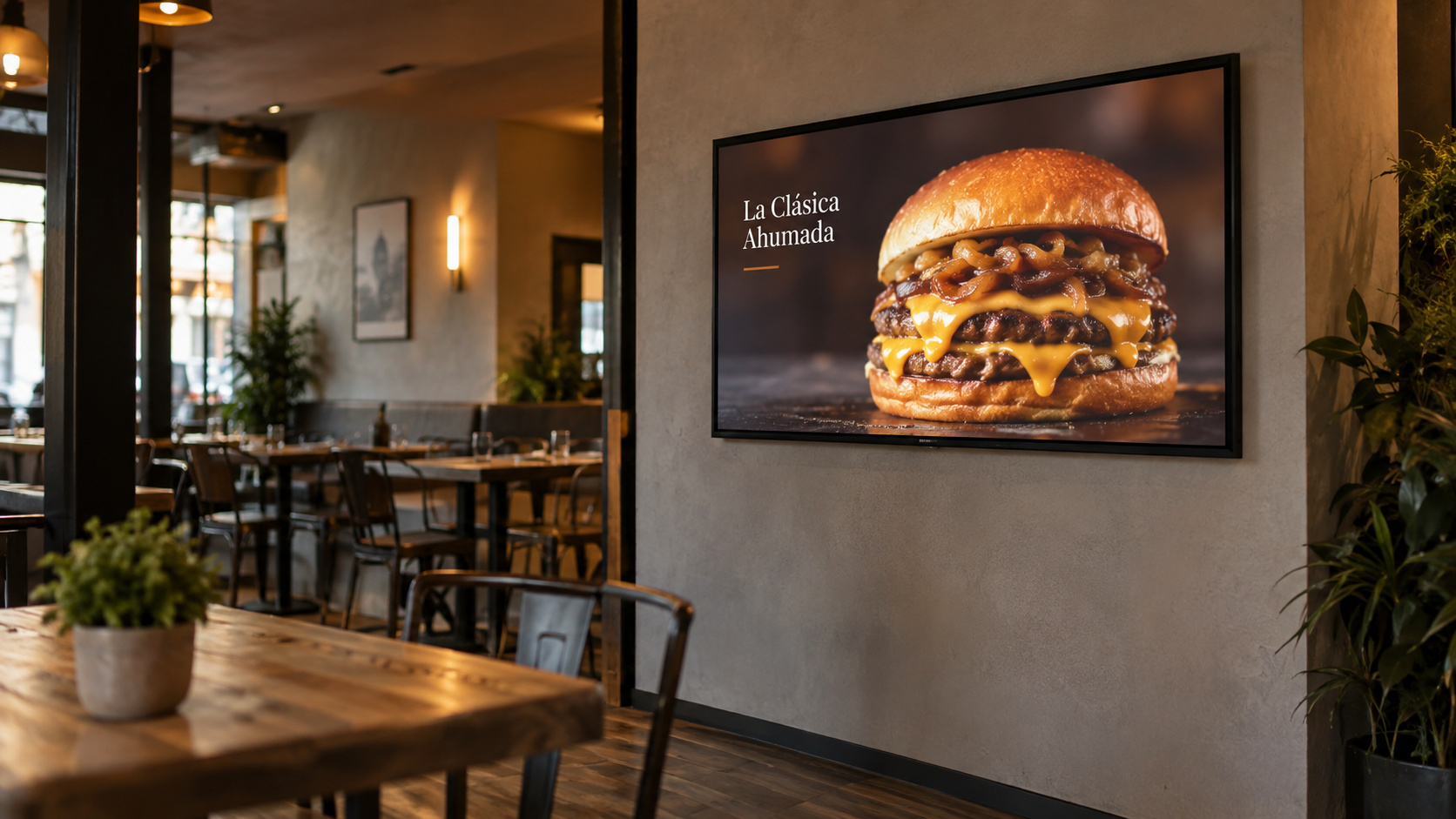
Artificial intelligence can help restaurant marketing in very concrete ways: generating ideas for promotions, writing messages, structuring campaigns and turning business information into proposals ready for review. It's not about replacing the owner or delegating important decisions, but about saving time and maintaining more agile and consistent communication. In this article you'll see which tasks you can make easier with AI, what data you need to provide, and how a real example — a burger called La Clásica Ahumada — can be turned into a screen campaign with human oversight.
Where AI can help
AI is especially useful for marketing tasks that require generating alternatives, writing copy and organising content from a base of information. For example: - Generating promotion angles: from the ingredients and characteristics of a dish, it can propose different communication angles. - Developing messages: writing descriptions, headlines or copy for digital signage. - Structuring promotions: organising a campaign in several steps or screens. - Turning business information into usable proposals: if you tell it which product you want to highlight and what objective you're aiming for, it can return a concrete proposal. The key is that AI works better when it receives real and specific data, not vague instructions.
What AI needs to know
To get useful results, AI needs facts, not assumptions. You must provide it with: - The specific product: name, type, characteristics. - The real ingredients or components, so it doesn't invent anything. - The campaign objective: for example, increasing sales at peak times or introducing a new dish. - Restrictions: what cannot be said, which prices or offers are allowed. It's important to differentiate between business facts and creative decisions. The facts (ingredients, prices, current promotions) are provided by you and must not be invented by the AI. The creative decisions (angle, tone, structure) can be proposed by the AI, but always under your review.
Practical example
Let's take La Clásica Ahumada, a smash burger from a restaurant, as an example. The authorised facts are: - Double smashed beef. - Cheddar cheese. - Caramelised onion. - Smoked sauce. - Toasted brioche bun. These data delimit what the AI can propose. It cannot add ingredients that don't exist, nor invent a price or a promotion. From this information, it can generate proposals like: 'Double smash, cheddar cheese and caramelised onion with a smoky touch', provided you have previously approved that approach. This flow demonstrates that the quality of the result depends on the accuracy of the data you provide.
On-screen demonstration: four slides from the example
AI with human oversight
AI can propose copy, structures and angles, but there are decisions that should always rest with the restaurant: - Prices and promotions: should not be invented by AI; you must provide or approve them. - Ingredients and product descriptions: AI should not add information you haven't given it. - Final validation: always review the result to ensure it complies with your brand image and local regulations. In the example of La Clásica Ahumada, AI could suggest an attractive headline, but you decide whether it's appropriate and whether the ingredients and prices shown are correct. Human oversight is what turns a generated proposal into a reliable campaign.
Application with iMediaGO
iMediaGO lets you apply this flow naturally: you enter your restaurant and product information, define the objective and restrictions, and the platform helps you create screen campaigns. You review and approve each proposal before publishing. In this way, AI becomes a support tool that speeds up content creation for your screens, without you needing to be an expert in design or artificial intelligence. The result is more consistent and coherent communication with your business.
Try iMediaGO in your restaurant
Create and publish campaigns for your restaurant screens based on the real information of your products, with the help of AI and your oversight.