
Restaurant marketing
Sunday family meals: how to promote a family menu in your restaurant
A Sunday family menu can be easier to choose when it is presented as a complete, recognisable occasion. The key is to explain what the restaurant is offering, make the contents clear and structure the information before each diner starts making an individual choice.
Sunday as a recurring commercial occasion
Sunday lunch has one particularly useful characteristic for a restaurant: it can be positioned as an occasion that comes around every week. Rather than communicating only the dishes available, the restaurant can give that moment a clear identity and help customers recognise an offer created specifically for Sunday. That repetition builds familiarity. If customers consistently encounter a “Menú familiar de domingo”, they do not need to work out from scratch what the restaurant is trying to highlight each week. The name of the offer, its availability and its visual presentation can all become recognisable signals. This also changes the question the communication needs to answer. It is not simply about saying “we have food”, but about making it clear that there is an offer linked to a specific occasion: a shared family meal available on Sundays. Repeating it each week can strengthen recognition without turning every Sunday into a different promotion. For the person running the restaurant, the first practical step is simple: define the occasion as clearly as you would define a dish. In this example, the constant element is the “Menú familiar de domingo” and its availability exclusively on Sundays. That provides a consistent starting point for everything else you communicate.
A family menu should not be communicated like a single dish
Promoting an individual dish usually focuses attention on that product: its image, its name and, where relevant, its price. A family proposition needs to explain something broader. Customers need to understand that they are looking at a shared-meal option, not simply another item on the menu. In the approved example, the Menú familiar de domingo includes Spaghetti, Hamburger, Pizza, Fish, Ice cream and Coffee. Communication can use these items to make the proposition tangible, but without turning them into six separate adverts. The main message remains the family menu and the Sunday occasion; the dishes help explain what it includes. That distinction matters because a list of products forces customers to reconstruct the proposition for themselves. A well-structured message does the opposite: it first identifies the option — Menú familiar de domingo — and then provides the information needed to understand it. It therefore helps to move from the general to the specific: first the occasion and the proposition, then the contents, and finally the information needed to decide, such as availability and price when confirmed. In this way, each component supports one shared idea instead of competing for attention.
Make the proposition recognisable before individual choices begin
A family proposition becomes clearer when customers can identify it before they start comparing individual dishes. If the first information they see is a series of separate products, they can quickly switch into individual-choice mode: one person looks at the pizza, another at the fish and someone else at dessert. The family menu then stops functioning as a complete option and slips into the background. To avoid this, the communication should first establish a clear point of reference. “Menú familiar de domingo” can play that role. Its availability — Sundays only — should appear close to that message, followed by enough information to make the proposition understandable. Placement is part of the same logic. On a digital screen in the restaurant, the proposition needs enough visual priority to be understood as an option before a sequence of product messages disperses the viewer's attention. Not all the information needs to appear at once; what matters is that the order is unambiguous. A practical test is to look at the communication for a few seconds and ask what you understand first. If the answer is “pizza”, “hamburger” or another individual dish, the hierarchy may be pushing the family proposition into the background. If you recognise the Menú familiar de domingo first and then discover what it includes, the structure is doing its job more effectively.
Which information should take priority on a digital screen
A screen offers limited space and limited viewing time, so giving every piece of information equal weight usually reduces clarity. For a family menu, the hierarchy should help viewers answer four questions quickly: what is it, what does it include, when is it available and how much does it cost when the price has been approved. In this example, the first layer is “Menú familiar de domingo”. The second explains the approved contents: Spaghetti, Hamburger, Pizza, Fish, Ice cream and Coffee. “Sundays only” provides the timing context. The approved price is 49,90 € and can be included as decision-making information without necessarily making it the sole focus of the message. Visual hierarchy does not mean putting all of these elements onto one overcrowded screen. The information can be distributed across different spaces or moments, provided the relationship between them remains clear. One message can identify the proposition and another can expand on its contents, for example, without introducing features the restaurant has not confirmed. It is also worth distinguishing information from decoration. The menu name, its contents, availability and price are concrete facts. Graphic elements should make them easier to read, not compete with them. The faster customers can reconstruct the proposition, the less effort they need to assess it.
Combine atmosphere, food and copy without losing clarity
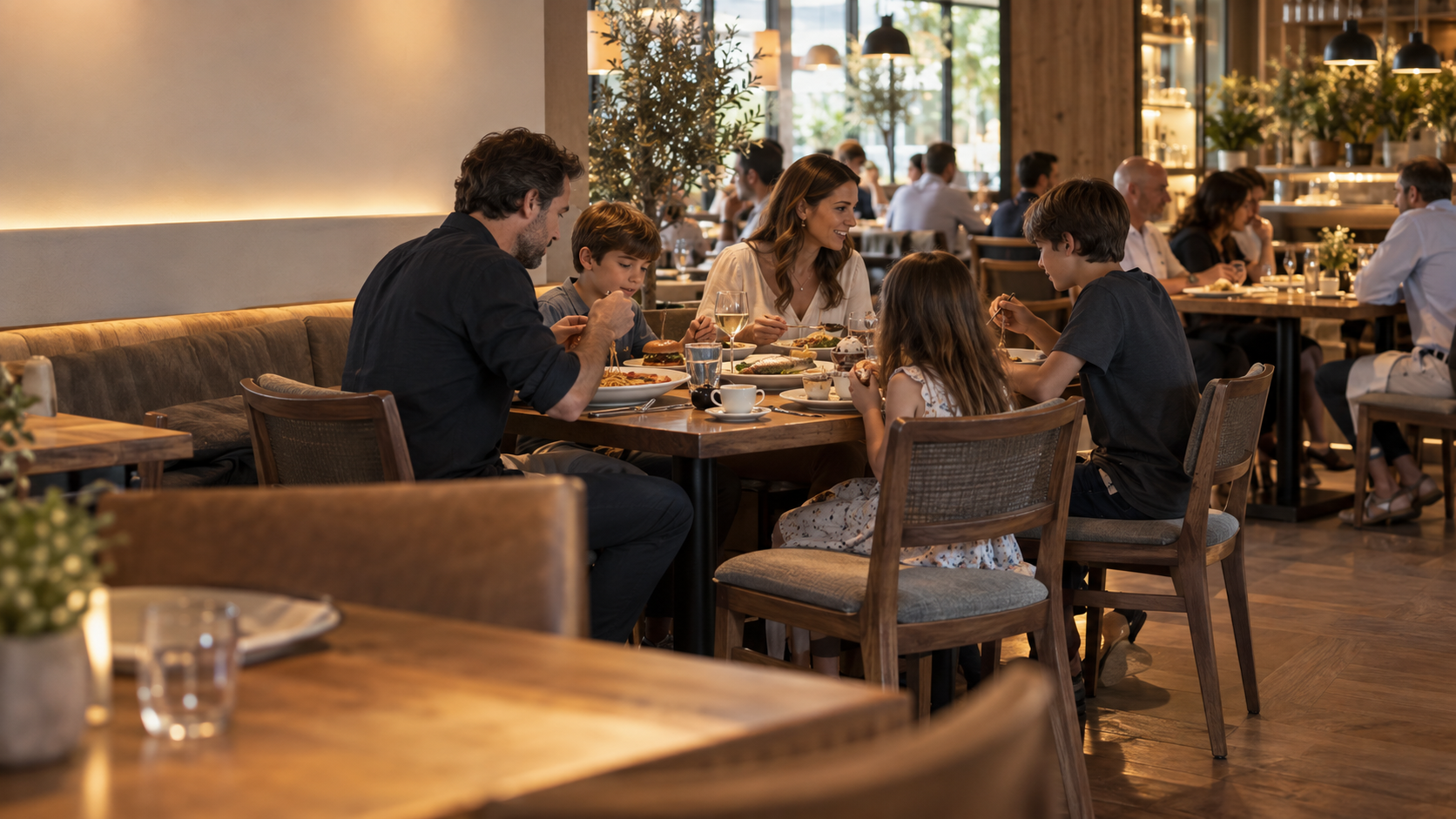
A Sunday family meal has two dimensions that the communication should keep together: the experience of sharing a table and the restaurant's specific proposition. If you show only the atmosphere, the message may feel appealing but too vague. If you show only dishes and price, you can lose the sense of a shared occasion that makes the proposition distinctive. Images can handle the first part by showing a shared table, a recognisable restaurant setting and a relaxed atmosphere. The approved dishes can appear naturally within that scene, but they do not all need to become separate close-ups. The aim is for the food to form part of the experience while remaining consistent with the menu being communicated. The copy should make explicit what the image cannot explain on its own. A clear name such as “Menú familiar de domingo”, supported by availability and the relevant offer details, reduces the need for long sentences. On a screen, a few well-prioritised words are usually more useful than a paragraph nobody has time to read. The combination works when each element has a job: the scene establishes the occasion, the food imagery connects that occasion to the restaurant, and the text identifies the proposition. None of them needs to carry the entire message on its own.
How to keep the communication fresh every Sunday
A recurring proposition does not need a completely new campaign every week. In fact, keeping certain elements consistent can help customers recognise it. The aim is to find the right balance between consistency and renewal. It makes sense to keep the elements that identify the proposition stable: the name “Menú familiar de domingo”, its association with Sunday and a recognisable information hierarchy. From that base, secondary elements can vary, such as image composition, the framing of the table or the visual arrangement of the information, without changing the facts of the menu. Another practical approach is to build a reusable structure. One space identifies the proposition, another presents its contents, and another communicates availability and price. On subsequent Sundays, the visual execution can be refreshed while retaining that logic. This avoids starting from a blank screen every time and also reduces the risk of the communication losing consistency. Before publishing a new version, it is worth checking three things: that it is still immediately recognisable as the same Sunday proposition, that the information shown remains correct, and that any visual variation improves attention without changing the meaning. Refreshing the communication does not require reinventing it.
From editorial structure to a campaign visible on screen
Once the communication logic has been defined, the next step is to see it applied to a sales-focused digital signage campaign. The demonstration should preserve the priorities already established: make the Sunday occasion recognisable, explain the proposition, make the relevant information easy to understand and guide customers towards a decision. At this stage, it is important to distinguish editorial structure from the final creative execution. The article establishes what the customer needs to understand and which facts are available; the campaign can then decide how to turn that structure into a specific visual sequence with its own concept, narrative progression and graphic treatment. The following four spaces represent that functional structure. They do not prescribe the final copy or the campaign's creative arc; they act as connection points between the article's explanation and the finished demonstration.
Demonstration: structure for the Menú familiar de domingo
Turn the proposition into communication ready for your screens
Once the restaurant knows what it wants to communicate, the task stops being about inventing messages and becomes one of turning a defined proposition into clear screen-ready content. The Menú familiar de domingo already has an identity, approved contents, availability and price; these elements can provide the basis for communication without rebuilding the proposition every week. iMediaGO can support that next step as a way to create and publish the resulting communication on digital screens. The priority remains the same: keep the occasion recognisable, present the information clearly and adapt the visual execution without losing the consistency of the proposition.
Bring your Sunday family menu to your screens
Define what customers need to understand, organise the information in your proposition and turn it into digital-screen communication with iMediaGO.