
Digital signage for restaurants
What to show on restaurant screens: 4 ideas to make better use of them
A screen does not have to show the same menu over and over. It can highlight dishes, make updates easier, promote events and become another touchpoint with your customers.
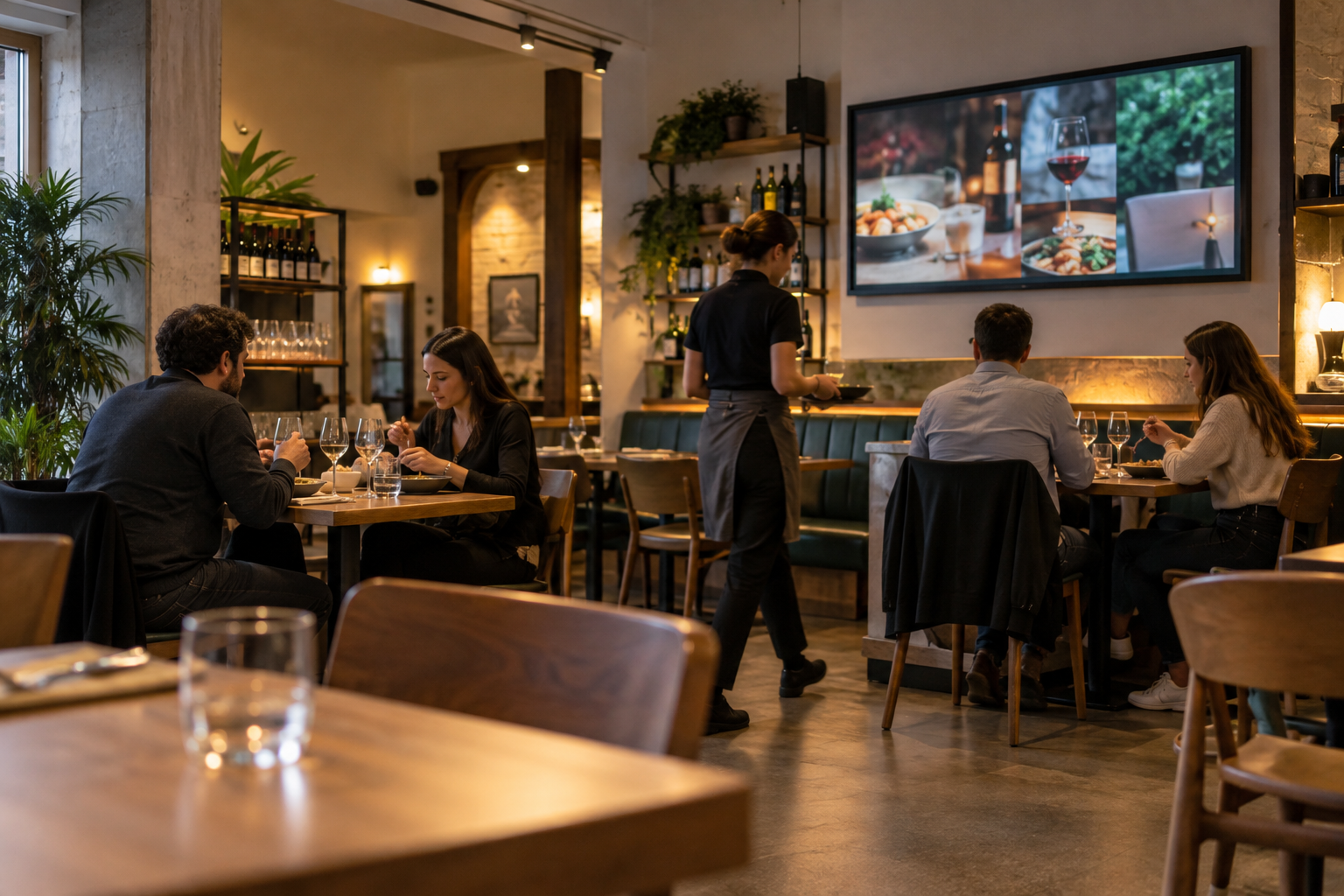
More than a screen with a static menu
Many restaurants install a screen and, over time, end up showing the same menu or promotion again and again. In that case, the problem is not necessarily a lack of screens: it is that the available content is serving only one purpose. Starting with the objective changes the approach. The same screen can draw attention to a particular dish, present the full menu, promote an event at the venue or strengthen the relationship with customers. Content stops being a fixed element and starts responding to different business needs. The following four ideas show how to put this approach into practice with specific examples of content for restaurant screens.
Showcase your dishes and increase average spend
A menu needs to present options, but that does not mean every item has to receive the same amount of attention all the time. A digital screen lets you change the hierarchy and set aside particular moments or spaces to highlight a specific product. For example, seafood paella at 19,90 € can take centre stage in a dedicated piece of content instead of appearing only as another line on the menu. The editorial purpose of that screen is simple: to make a chosen product more visible and easier to spot. This approach lets you use digital space with a specific commercial purpose without turning all of the restaurant's communication into a stream of promotions. The restaurant decides what it wants to highlight and uses the screen to give it a distinct presence.
Save time and costs without printing
Another practical use of digital screens for restaurants is to present information that may need to change, such as the menu and its prices, without having to produce new printed signage every time the content is updated. For example, a Mediterranean menu on screen could be organised into Starters — Homemade croquettes, 8,50 €, and Mediterranean salad, 9,50 € —; Mains — Seafood paella, 19,90 €, and Grilled sea bass, 18,50 € —; and Desserts — Cheesecake, 6,50 €, and Crema catalana, 5,90 €. The benefit is not simply having a digital version of the menu. It is having a medium whose content can be changed without producing physical materials again. This is particularly useful when a restaurant needs to keep the information customers see aligned with its operational decisions.
Promote events at the right time
The screen does not have to function as a menu throughout the day either. If the restaurant is hosting a particular event, part of its schedule can be dedicated to promoting it, temporarily giving the screen a different role. A piece of content saying “Live music night — Friday, 21:00” turns the screen into a channel for communicating what is happening at the venue. The message is brief, specific and serves a different need from presenting dishes or prices. Timing is key. An event has a defined window of relevance, so the screen can give it visibility while that information is useful and then make room for other content.
Turn the screen into another customer touchpoint
Not everything shown on a screen has to try to sell a dish. It can also be used to extend the relationship between the restaurant and the people who visit it. A message such as “Follow us and share your experience” does exactly that: it shifts the focus from the product to the community and uses a touchpoint inside the venue to invite customers to continue the relationship beyond their visit. Alternating this kind of communication with menus, products and events helps prevent the screen from being perceived purely as a sales catalogue. It can become part of the restaurant experience and identity without resorting to testimonials, reviews or messages that do not come from real customers.
One screen, different objectives
All four examples use the same medium, but they do not serve the same purpose. Highlighting the paella draws attention to a product; presenting the full menu organises useful information; promoting the live music night communicates an event; and the social message creates another customer touchpoint. That is one of the keys to making better use of digital signage for restaurants: instead of asking only what design to put on the screen, ask what the business needs to communicate at any given moment. Content can be adapted according to the time of day, the day itself or a specific need. A screen that displays the menu for one period can highlight a product or an upcoming event at another time. In this way, the same digital space can serve different objectives without requiring a separate medium for each one. To explore how this approach fits into a broader strategy, the iMediaGO digital signage for restaurants page is available at /es/industry/restaurant-digital-signage.
Create, organise and publish content with iMediaGO
Once a screen starts serving several purposes, being able to manage the content shown on it also becomes important. iMediaGO lets restaurants create, organise and publish this type of content to their screens, so they can work with different pieces depending on what they need to communicate. Technology is the medium; the important decision remains editorial: choosing which information deserves prominence, when it should be shown and what purpose it serves within the venue.
Restaurant project: four uses for one screen
Bring these ideas to your screens
Create, organise and publish different content for your restaurant screens with iMediaGO.