
Restaurant Marketing
First capture attention. Then show the price.
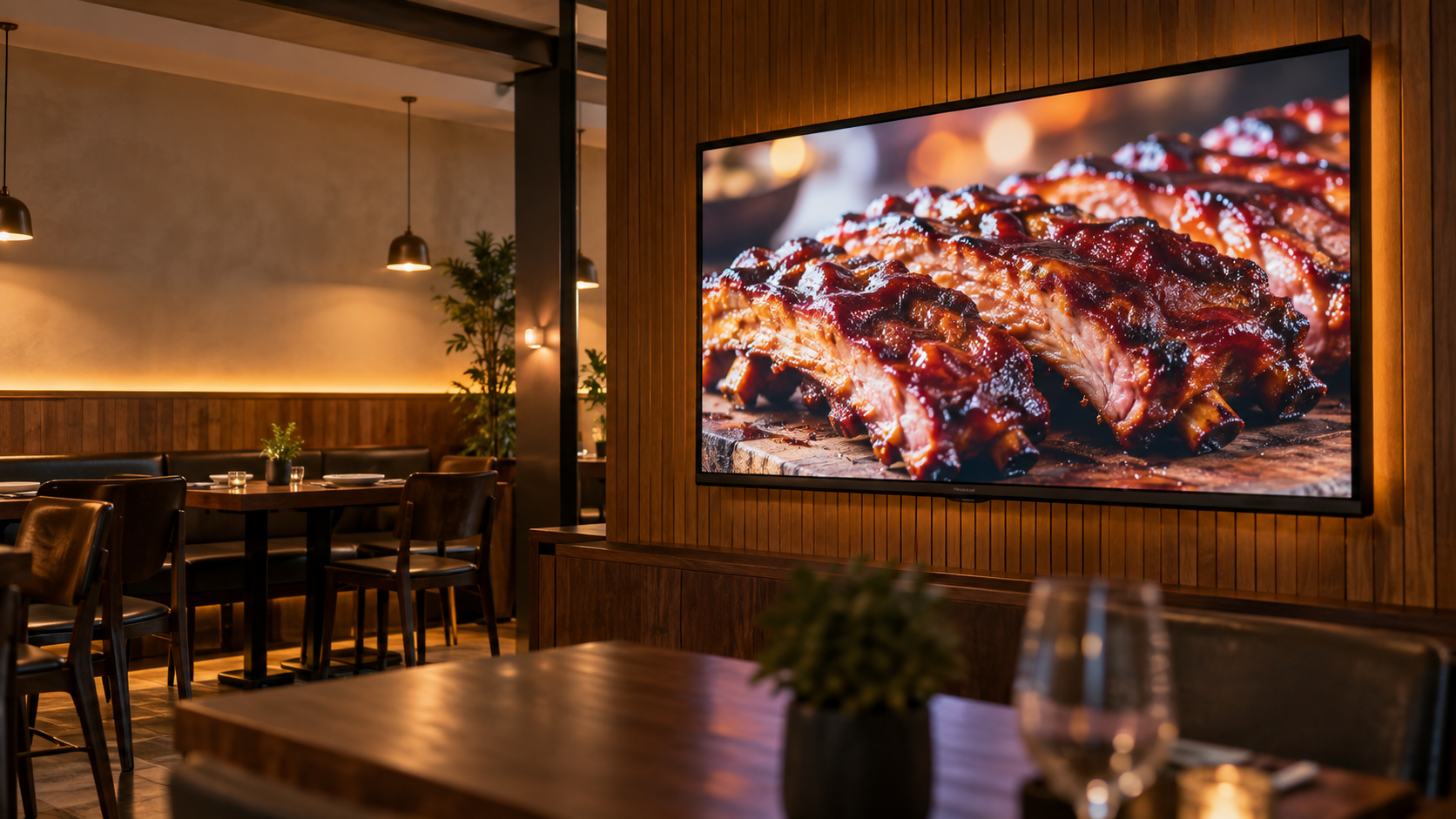
On a restaurant screen, price shouldn't always take centre stage. We explain how to catch the eye with the product and present the price at just the right moment, with a practical example of Costillas BBQ.
The battle for attention in seconds
When a customer enters your restaurant, their attention is divided between the smell, the sound, the tables and, very likely, a screen showing your dishes. That screen competes with many stimuli and, in most cases, only has a few seconds to catch the eye. If the first impression is a wall of text, prices and logos, the impact is likely to be diluted. Instead, a powerful image of the product can stop the gaze and start to build desire. In this article you will see how to organise a restaurant screen promotion so that attention is the first objective and the price appears when it can really help the customer decide.
The mistake of showing everything at once
Many restaurant owners think that the screen must communicate all the details of a promotion immediately: dish name, price, description, offer and logo. But the human eye does not process all that information simultaneously; it needs a visual hierarchy to guide it. If you put the price at the same level as the image, the main message can get lost. The problem is not showing the price, but competing for attention on too many fronts at once. The customer may be left with a feeling of visual noise and walk past without having understood what you offer.
Attention, desire, product and decision: a useful sequence
For this specific promotion, we propose a four-stage progression: first capture attention with a dominant image; then arouse desire with sensory details; then present the product in a recognisable and appetising way; and only at the end provide the commercial information needed to decide, including the price. This sequence is not a universal rule, but it works especially when the goal is to introduce a dish or reinforce its appeal. Delaying the price does not mean hiding it: it means giving it a clear place once the customer is already interested.
Four-slide demonstration: Costillas BBQ
Visual hierarchy principles for your next promotion
Several practical lessons can be drawn from the above campaign. Photography rules: the dish should be the largest and brightest element; avoid cluttered backgrounds. Less is more: each slide should communicate a single idea; if you want to say two things, split it into two slides. Recognise the product: the customer must clearly identify what they are seeing; the name and visible ingredients help. The price has its own moment: if it appears at the end, it is perceived as a logical close rather than an interruption. Apply these criteria also to short texts and call-to-action buttons.
When the price can be the main hook
The sequence attention → desire → product → decision is not the only valid one. When a promotion is based on a very competitive price, a special offer or a limited-time discount, the price itself can be the element that captures attention. For example, if you offer a menu at an unusually low price, that number can occupy the first slide. The key is to consciously decide what is most relevant for your customer at that moment. If economic value is your main advantage, communicate it from the start; if the appeal is the product, let it speak before the price.
Common mistakes and how to avoid them
Trying to say everything on one slide saturates and confuses. Repeating the same hierarchy on every slide prevents progression. Introducing the price without context makes the number meaningless. Assuming that the price must always be huge or always secondary depends on the promotion and the objective. Before publishing, ask yourself what the customer should understand in the first two seconds and build the sequence that responds to that need.
How iMediaGO helps you create on-screen sequences
Creating this type of sequential campaign may seem complicated, but with iMediaGO you can design and publish slides for your restaurant screens easily. The platform allows you to organise content into steps, choose images and texts, and control the duration of each slide. This way, you can apply the attention → desire → product → decision hierarchy without needing to be a designer. iMediaGO integrates as a natural tool to keep your visual promotions up to date and aligned with your point-of-sale marketing strategy.
Apply the hierarchy in your restaurant
Ready to create promotions that catch the eye before asking for the decision? Try iMediaGO and discover how easy it is to publish sequential campaigns on your screens.