
Digital signage for sports clubs
What to show on sports club screens to inform, promote, and connect with your members
Digital screens can be much more than advertising: they handle recurring information, give visibility to activities, support in-house sales, and strengthen the community.
The screen that adds value to the club
Many sports facilities have screens switched on that repeat the same promotion for weeks. That unused screen could answer recurring questions, encourage members to try new classes, or remind them that useful products and events are available at the club.
Digital signage in a sports club does not replace reception staff or direct member communication. It complements the experience: it informs without overwhelming, suggests without pressure, and creates a visual channel that is always available in shared spaces.
To make it work, it is not enough to turn a TV on. You need to choose deliberately which types of content belong on the screen and what each one is for. Below we cover four of the most practical content uses, using the Arena Sports Club demo project as an example.
Useful information at a glance: schedules and classes
One of the most valuable uses of a screen is to display recurring information that members check every day: pool hours, group classes, open-use time slots, or operational reminders.
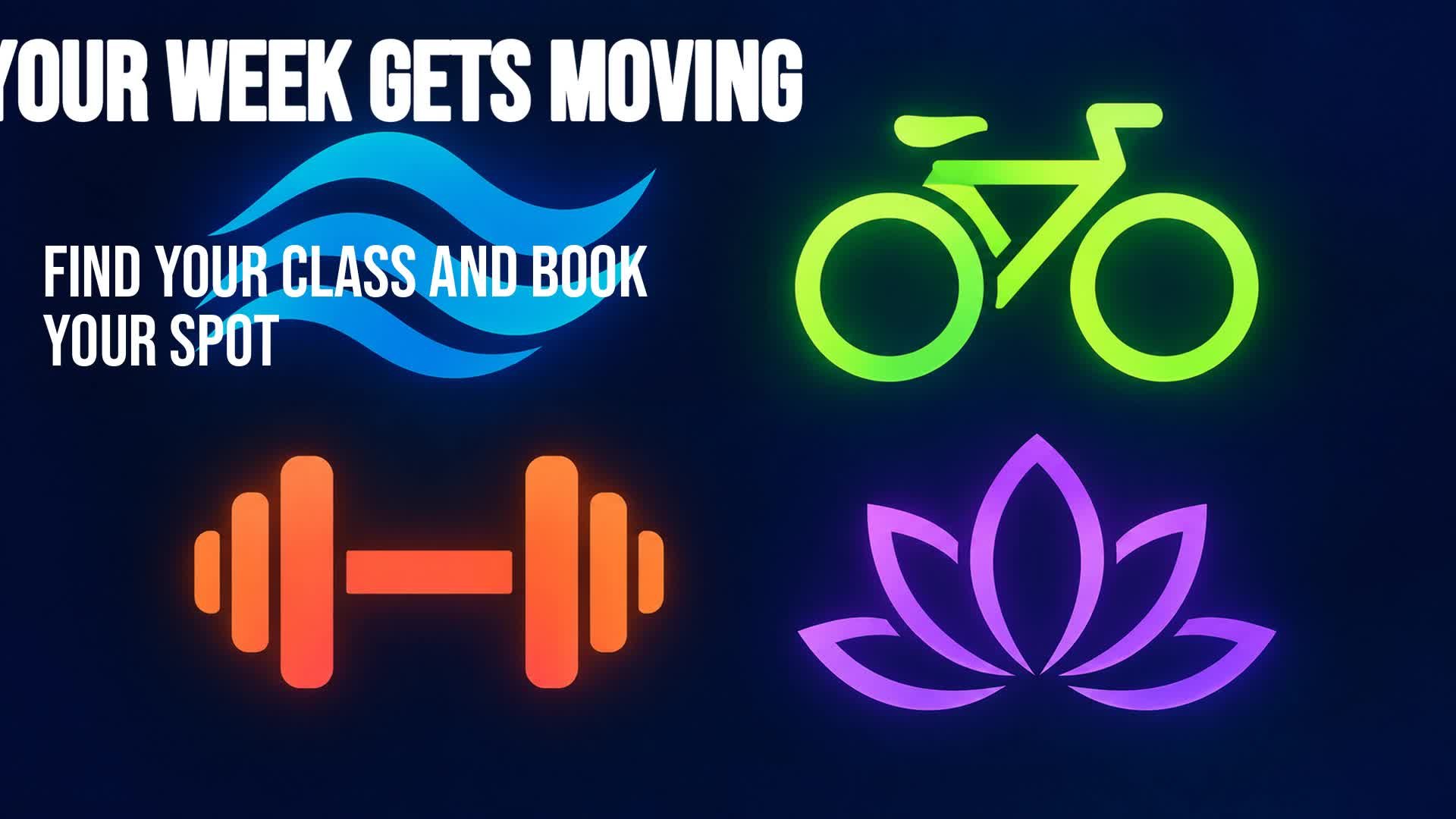
At Arena Sports Club, for example, the first screen is designed to show the weekly schedule for adult swimming, aquagym, cycling, and pilates. This information is not advertising; it is a service. Members don’t have to ask at reception or open an app: as they pass through the lobby they can quickly see if their class starts in 15 minutes.
The key is legibility: large fonts, high contrast, and brief messages. Schedules must be easy to update, especially when there are last-minute changes or facility closures. If updating the screen is a slow process, it will end up showing outdated information and lose credibility.
Highlight an activity to boost participation
Many clubs offer excellent activities that go unnoticed by some members. Screens allow you to give a specific activity momentary prominence, with a clear message and an invitation to try.
In the case of Arena Sports Club, one of the screens is dedicated to adult tennis classes. It’s not about saturating with promotions, but about catching the attention of members who may not know that the club offers this service or who have never considered signing up.
The content should be visually attractive, with a direct phrase and an obvious next step (for example, ask at reception or scan a code). Avoid including too many details on screen; the important thing is to spark interest and facilitate later contact.
Selling within the club without being intrusive
The club is not just a place to train; it can also have its own products or partners’ products that generate additional income. Screens are a natural showcase for items such as technical t-shirts, sports bottles, or towels, as long as they are presented as a convenience and not as aggressive advertising.
At Arena Sports Club, one of the slides shows three products available at the club: a technical t-shirt, a sports bottle, and a towel. No prices on screen, no urgency phrases, just visibility. A member who needs a bottle for their class or a spare towel will know they can buy it right there.
This type of communication works best when it alternates with informational and activity content. If the screen only shows products, it loses usefulness and is ignored. In-house sales should be a complement, not the protagonist.
Events that build community
Tournaments, internal leagues, and social activities are an important part of club life. Often the problem is not organisation, but communication: members don’t find out in time or don’t perceive that the event is for them.
A well-placed screen can generate anticipation and participation. At Arena Sports Club, one of the screens is reserved to announce a social padel tournament for members. Without needing to give all the logistical details on screen, a simple announcement with a clear message is enough for many members to ask and sign up.
The rule is simple: event content must convey excitement and belonging. Use bright colours, real photos of past activities if available, and a call to participate. Avoid overloading the screen with legal fine print or complicated dates; that can be checked on another channel.
This is how it looks at Arena Sports Club
Practical rules for managing content
Once you know the four content uses, a few practical rules help screens actually work:
- Readability first: large type, high contrast, few words per slide. - Update without friction: if changing a schedule takes more than five minutes, you will postpone it. - Mix content types: do not show only promotions or only schedules; alternate useful information, classes, products and events. - Design for distance: viewers usually walk past a few metres away; avoid tiny text and unnecessary detail. - Use a clear call to action: “ask at reception”, “book in the app” or “ask about the class” works better than vague phrases.
These rules do not require advanced technical knowledge — just communication discipline and a tool that lets you update content quickly.
When you already know what to show, the next step is turning those contents into planned campaigns with a goal, CTA and schedule: /en/magazine/sports-club/digital-signage-campaigns-sports-clubs.
iMediaGO: from idea to screen without friction
All of the above sounds reasonable, but the main obstacle is usually day-to-day management: creating designs, exporting them, transferring to a USB, going screen by screen... That process consumes time and demotivates teams.
iMediaGO solves exactly that operational problem: it allows you to create, schedule, and update screen content from a single platform, without depending on an external designer or manual processes. With templates adapted for sports clubs, you can prepare a schedule slide, a tennis class promotion, or a tournament announcement in minutes.
It’s not about turning the club into a technology centre, but about removing friction so the screen fulfils its purpose: inform, promote, and connect with members.
Start improving your club's communication
Try iMediaGO to create and manage your sports club's screen content easily and professionally.